
RULES FOR RECORDED CONVERSATIONS
"Issue": 146
Our industry is quite good at recording itself. We don’t shy away from prediction. We flex up and down on the “status” of shows. We don’t look down on high quality media personalities that are organic to our culture. And everyone has at least sat down with a couple friends, and a couple of microphones, and said “what the hell” at least once.
As a result we see a lot of different styles of conversation. A lot of pulls for our attention. But what makes a “good” conversation? What makes a moment worthy of our attention?
The following are my rules for recorded conversation.
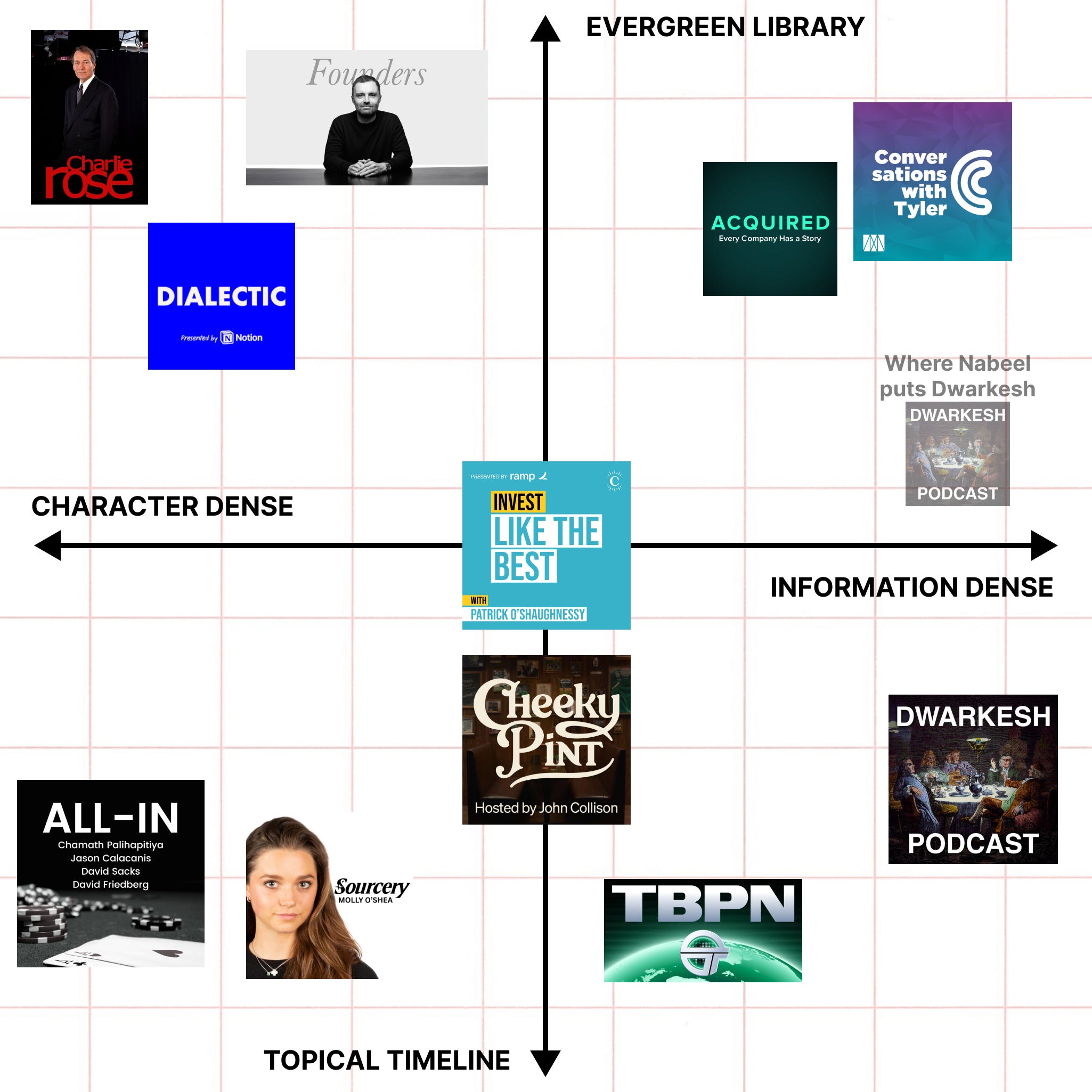
First and foremost, the point of recorded conversations is to say something new. There are many structural ways to ensure this is true. TBPN as a daily news show is programmed to focus on the newness of the day, not the “new” of yesterday. And as a result stays fresh. David Senra (who is sort of in conversation with the audience and the books) on Founders only repeats hard earned lessons that are shared across different episodes. But as a function of working through biographies, as long as he reads a new book → the problem is solved.
There’s any number of ways you could create a 2x2 matrix to organize the tech media landscape. And it will never be exhaustive. But this is always how I think about things: evergreen—timeline & character—information. Most people fail because they can’t commit to being defined long enough for viewers to build a mental model for why they should watch. Invest Like The Best somehow creates a true neutral. I don’t know how Patrick does it, but he does and it makes ILTB very special.
How does the previous point get tricky? When you’re functionally a documentarian of a present moment. The best example of this tension, is Dwarkesh. To me, Dwarkesh represents the definitive documentation of AI development. Yes he’ll bring a guest on to explain Machiavelli or present day China (and that’s part of the tension). But the beat is very clear. This is why I’d place him in a timeline grouping. However my friend Nabeel’s counterpoint is that Dwarkesh is “an oral history of the AI era” and as such should be (and will be seen in the Adam Curtis future as) evergreen.
To share more from this conversation here’s my response: It’s hard to tell. Like do you think his conversation with Ilya will matter next year? Or will we have too many advancements in AI for it to matter that much. I struggle with the pure AI focused content because of the pace of the environment the content has to map to.
Which leads me to…
The subject sets the expiration date. Content decays at the speed of its subject. Dwarkesh feels like timeline (to me) not because of anything about his format, but because frontier AI has a six-month half-life, so the container inherits the decay. Senra feels evergreen because dead founders don’t move. This is also what make venture media particularly tricky. It’s a narrative double down on a company that might crash and burn. Functionally killing it’s catalogue value.
Evergreen vs Timeline is a question of building catalogue value. Catalogue value is the simplest question in media and almost nobody asks it: what is this episode worth in three years? Acquired is a catalogue business — a new listener arrives in 2029, finds the Nvidia episode, and works backwards through six years of archive that never stopped earning. Every episode they publish makes the last hundred more discoverable. Founders is the same machine. TBPN, by contrast, has near-zero catalogue value by design. This isn’t a knock on the homies, the inversion is what makes it so valuable.
The problem with venture media is that catalogue value can go negative. Most media decays toward zero. It simply stops earning and sits there harmlessly. Venture media doesn’t. If you spend 90 minutes narrating why a company is inevitable and the company craters, that episode is now evidence for a group of Twitter haters waiting to say “I told you so, these people have no idea what their doing.” Some firms have the stomach for this, but most firms don’t and you’ll see a wave of media efforts fade just as cohorts of investments fade from the books.
One final test on catalogue value. If Founders stopped producing new episodes tomorrow. It would be quiet, but rich. People would still be “discovering” it for years to come. If you can’t say that about what you’re publishing… you are not creating catalogue value.
You can be in conversation with your guest, the audience, or object.
A rare and interesting one is to be the audience yourself. Joe Rogan sort of perfected this. He is a vessel, receiving a private show from his guests. Absorbing it all, no matter how off the wall the guest may be during the episode.
Dwarkesh shows signs of this (being the audience member himself) as he has guests essentially give full blackboard lectures as a format. (link)
Being in conversation with an object is, again, best shown through Senra working through biographies. He is rotating that object for everything it is worth, for the audience. A good version of this outside of tech would be Bliss Foster analyzing fashion.
The host has to disappear or dominate. One funny critique you’ll see in the comment section of Charlie Rose Youtube videos is folks saying “let the guest speak Charlie”. I think Charlie let’s the guest speak plenty, he simply represents an old school hands on the steering wheel style of interviewing that’s a bit rare now. Today I think hosts like to disappear, allow the guest to do the lifting and their curation of guests to display a type of world view. However, the more you have your hands on the steering wheel → the more diverse your guests can be because it’s no longer just a platform for the host to express their adoration.
A recorded conversation is well prepared. I often find the worst conversations simply haven’t had the appropriate amount of care put in. The most intimate example of care displayed through preparation comes from my good friend Jackson of Dialectic. I witnessed first hand Jackson prepping for a conversation, where he consumed everything possible on his guest. When I got into his car, he was listening to another podcast his upcoming guest was on — searching for that tidbit he could extend or challenge. One way to get somewhere new with a guest, is meticulously studying where they’ve already been.
Conversations are supposed to be a generative exercise, but recorded conversations are suppressed by the “pose” effect. In Camera Lucida, Roland Barthes reflects on the fact that once an individual is aware that a camera is on them → their entire sense of self shifts towards “pose”. The same is true for recorded conversations.
One way around this is to not do a single recording session. This is particularly true for the “character dense” side of the matrix. Similar to writing a profile for the New Yorker, you don’t create a kaleidoscopic portrait with a single sit down at the table. I don’t believe there’s a single tech conversation platform that does this today… but when someone does it well, I’m confident it will break through.
Another way to push through this is in the cut. The cut is where the pose gets shaved away. The most hardcore view of this would be taking a 2 hour conversation and cutting down to a genuine 30 minutes that doesn’t feel like the media coach is in the corner like a sleep paralysis demon. But this is difficult when the current cultural attitude around long-form is that it’s a marker of authenticity to show conversations in their fullness. Even I struggle with this editing ruthlessness.
Design a mechanism for disagreement. Maybe it’s a type of tech industry politeness, maybe it’s wanting to attract future guests. But one of the worst things about tech media, especially as technology has gotten more hostile towards traditional media, is that there isn’t any room for recorded disagreement (let alone critique). Consensus is the most reliable sign that nothing new will be said… and we’ve already established that we’re in search of newness.
The other obvious reason why we don’t have mechanisms for disagreements in our conversations is because we are actively doing business through these conversations. When hosts are investors or founders themselves, when their guest might have the hottest Series C loading in the wings. We lose the affordance of true candor. The host can’t need anything from the guest, other than their presence for the real and now conversation.
I often get asked about the aesthetics of tech media so here’s the most direct thing I can say. Aesthetics matter in so far as they signal something about the conversation. Most recorded conversations have the exact same structure. Two folks sitting in Herman Miller office chairs at a wood table. And this is fine. It places the technologist in a setting that reminds them of work, and thus their attention will be used well because you might be able to learn something that you’ll apply at work. It’s a clean 1:1 relationship. But as a general note, I believe that the aesthetics of a conversation can be just as intentional as the conversation itself. This should be abundantly clear by the General Catalyst interview series we designed this year. A stark studio backdrop, shot in black and white in order to strip everything back to the quality of what is being said. Yet, still visually distinct to standout in the sea of sameness as your scroll Twitter.
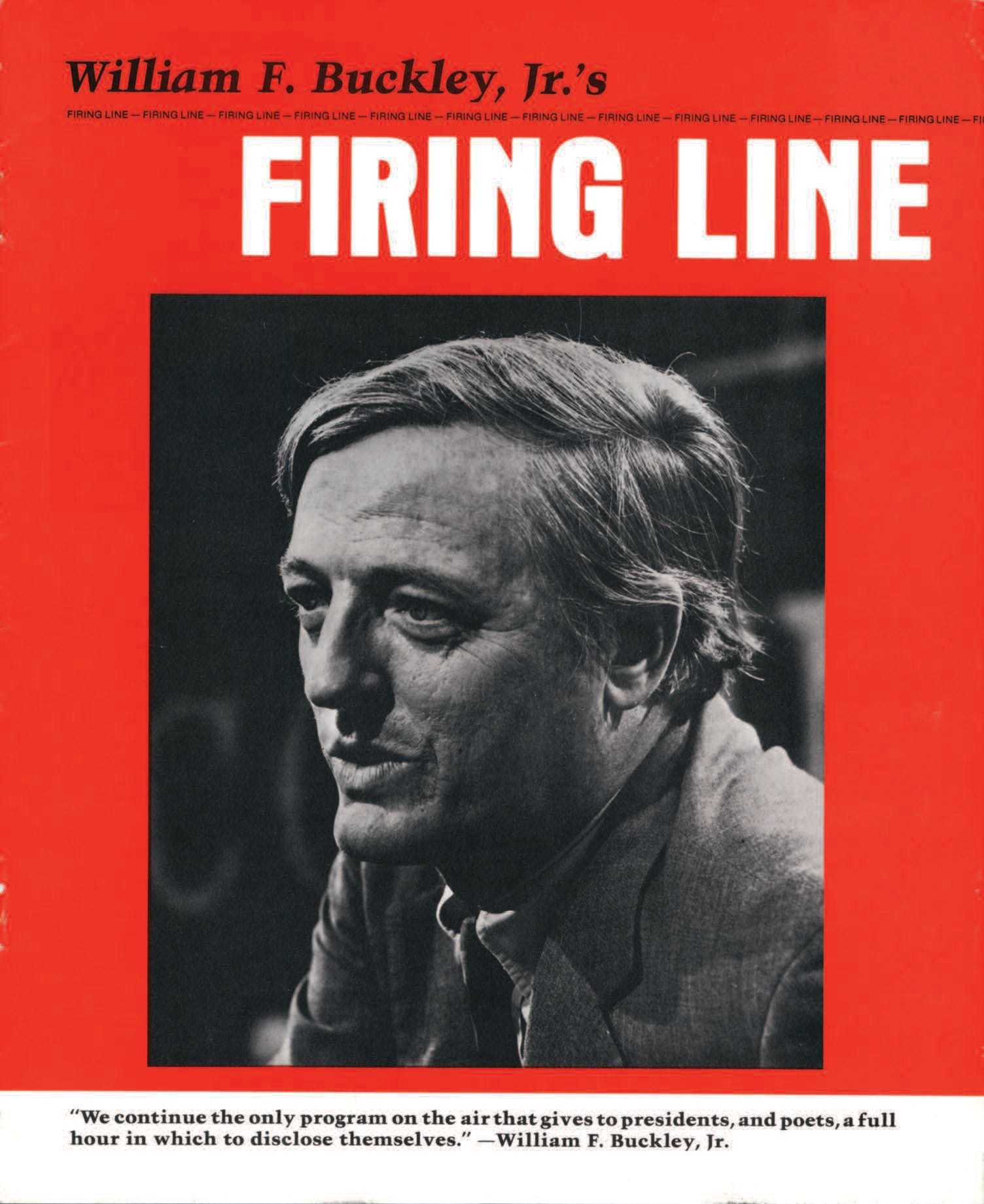
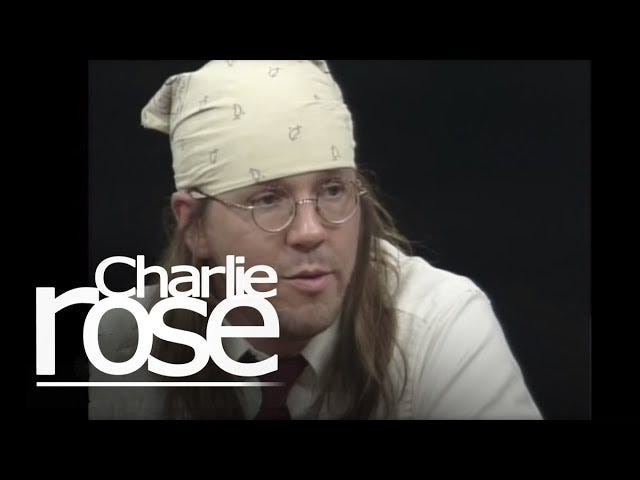
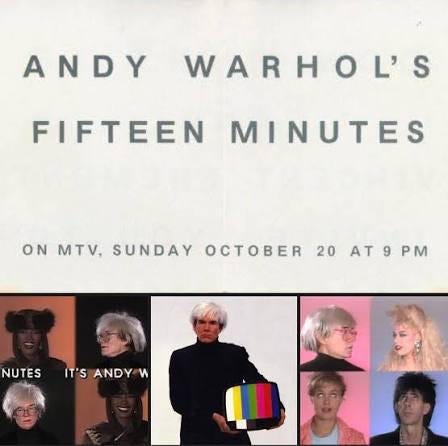
Finally, care about history. Recorded conversations are not new, in case that bewilders some Brooklynite that just bought the Teenage Engineering microphone set up because his version of How Long Gone is going to have some real substance, some true understanding of the culture. Youtube is the treasure trove of shows like Firing Line with William F Buckley to Charlie Rose (my personal favorite interview show of all time). Dig dig dig through the archives. You’ll be both encouraged that we’re all searching for the magic within each other, and inspired to continue the lineage of maybe an unappreciated show that you can pull forward once more.
I don’t do edits really, so excuse typos and things that don’t make sense.
Thanks so much for giving me your attention. I hope it was worth it, if not… unsubscribing will not hurt my feelings, and will give you back time you literally cannot have back.
Much love.
Live in the light
Disclaimer